




The creatine guide · Format comparison · 2026
Creatine gummies: do they work as well as powder?
The effect is in the dose, not the format. Here is the full comparison.
Creatine gummies are creatine monohydrate in chewable form. The effect comes from the creatine, not the format: as long as you get the same daily dose, the formats are equivalent. The differences lie in dose per unit, price per gram and what you actually take every day.
Here is what we sort out: what creatine gummies actually are, whether they work as well as powder, how capsules and tablets compare, how many units it takes to reach 3 grams, which format is cheapest and how to choose the right one.
What are creatine gummies?
Creatine gummies are creatine monohydrate cast in a chewable, flavoured form. Nothing more mysterious than that. The same molecule as in powder and capsules, just packaged as a gummy sweet instead of a powder you mix into water.
The mechanism of action is identical. Creatine tops up the muscles' rapid-energy store, phosphocreatine, which recharges ATP during the first seconds of a heavy contraction (the full mechanism is in our creatine guide). Sprints, lifts, explosiveness. How the creatine gets into your body makes no difference to how it works once inside, as long as the dose is right.
The only structural difference from powder is in the gel base. Many gummies are made with gelatin, which is animal-based. Vegan versions use pectin from fruit instead. If you want a plant-based gummy, pectin is what to look for on the ingredient list. We go deeper into the choice of form in the creatine monohydrate guide, where the difference between creatine form (monohydrate vs HCL) and creatine format (gummy vs powder) gets sorted out properly.
Is creatine in gummies effective?
Yes, if the dose is the same. That is the whole answer, but there is one condition that often hides in the fine print.
The creatine in a gummy is the same creatine monohydrate as in a pouch of powder, with the same purity and bioavailability. If you take 3 g a day from gummies, you build up the same muscle saturation as with 3 g of powder. The research is done on monohydrate regardless of format, and your body does not read the packaging.
The catch is the dosing. Some creatine gummies on the market contain only around 1 g of creatine each, sometimes less. That means 3–5 gummies a day to reach 3 g, and if you take two you think you are dosing right when in practice you are at half the level. That is how the most common gummy disappointment happens: the product "does not work", but it was the dose, not the format, that was the problem.
So the rule is simple: work out how many gummies actually provide 3 g, and dose accordingly. A well-balanced gummy that gives you 3 g in three pieces is equivalent to powder. One that takes five for the same thing is more expensive and easier to underdose.
Capsules and tablets: same logic, different numbers
Capsules and tablets follow exactly the same principle as gummies: the right molecule, but the dose comes in small units.
A capsule holds roughly 0.75–1 g of creatine, because that is what fits. To get up to 3 g you are looking at 3–4 capsules daily, year round. Tablets sit at around 1 g each and land in the same territory, about 3 tablets for 3 g. Both work, both are easy to take with water, and both cost more per gram of creatine than powder, because you are paying for the capsule or the pressing.
Vegan status applies here too. The capsule shell can be gelatin or plant-based HPMC, and tablets can contain animal-derived binders. If it matters to you: check the label, just like with gummies.
In short, capsules and tablets are portable middle grounds. They solve the same thing as gummies, just without the taste, and with the same convenience premium in the price.
The dose maths: how many units it takes to reach 3 grams
The EFSA wording for creatine applies at 3 g per day. That is the benchmark, and this is where the formats differ most in practice. Here is what the dose maths looks like:
| Format | Typical dose per unit | Units for 3 g | Vegan? | Price per gram |
|---|---|---|---|---|
| Powder | 3–5 g per scoop | 1 scoop | Yes, if fermented | Lowest |
| Capsules | ~0.75–1 g | 3–4 capsules | Depends on the shell (gelatin/HPMC) | Higher |
| Tablets | ~1 g | ~3 tablets | Depends on the binders | Higher |
| Gummies | ~1 g | 3 (if well balanced) up to 5 | Depends (gelatin vs pectin) | Highest |
The point of the table is not to crown a winner, but to show that "one gummy a day" is rarely enough. Always read how many units the label requires for 3 g, and compare that with what you can realistically manage every day. No loading phase is needed in any format; a daily dose saturates the muscles within 3–4 weeks either way.

Which creatine gummies are best? The criteria that decide
The best creatine gummies are the ones that give you a full dose without eating half the pouch. Four things decide it, and all four are on the label.
- Creatine per gummy. Around 1 g is standard. Less than that, and your daily count runs away from you.
- Units for 3 g. Three is good. Five is a warning sign, for your wallet and for the habit.
- The sugar. A daily habit shouldn't be candy. Sugar-free options exist, pick one.
- The base. Gelatin is animal-derived. If you want vegan, pectin is what you're looking for.
Then always count price per gram of creatine, never price per pouch. More on that in a moment.
Price per gram: why powder is cheapest
Count per gram of creatine, not per pack, and the picture becomes clear straight away.
Powder is cheapest because you are paying almost entirely for the raw material. No shell, no moulding, no flavouring. Capsules and tablets add the manufacturing cost of the unit itself. Gummies sit highest, because there you are paying for the gel base, flavour, sweetening and a more elaborate production.
That does not mean gummies are a bad buy. It means you are paying a convenience and taste premium, and that can be worth every krona if it is the difference between taking your creatine daily and letting the pouch sit untouched. But if you think you are saving money on gummies compared with powder, do the maths per gram. If you want to compare pure options, you will find them in our creatine collection.
Which format suits you?
The right format is the one you actually take every day. Consistency beats everything else, because creatine works through constant saturation in the muscle, not through single doses.
- Powder if you want the most creatine for your money and do not mind mixing a shake. Cheapest per gram, biggest pouch, least hassle at home.
- Capsules or tablets if you travel a lot or want something completely tasteless to swallow with water. Portable, but more expensive per gram.
- Gummies if the taste and the ritual are what make you remember the dose. Chewable, tasty and no water needed, at a higher cost per gram.
If vegan is a requirement: choose a powder fermented without animal ingredients, or gummies made with pectin instead of gelatin. And whatever the format, aim for 3 g daily and keep it consistent. Miss a day, carry on the next. Miss three weeks, and your stores start to drop.
How Heey does it
We make creatine in two formats, and honesty is the whole point.
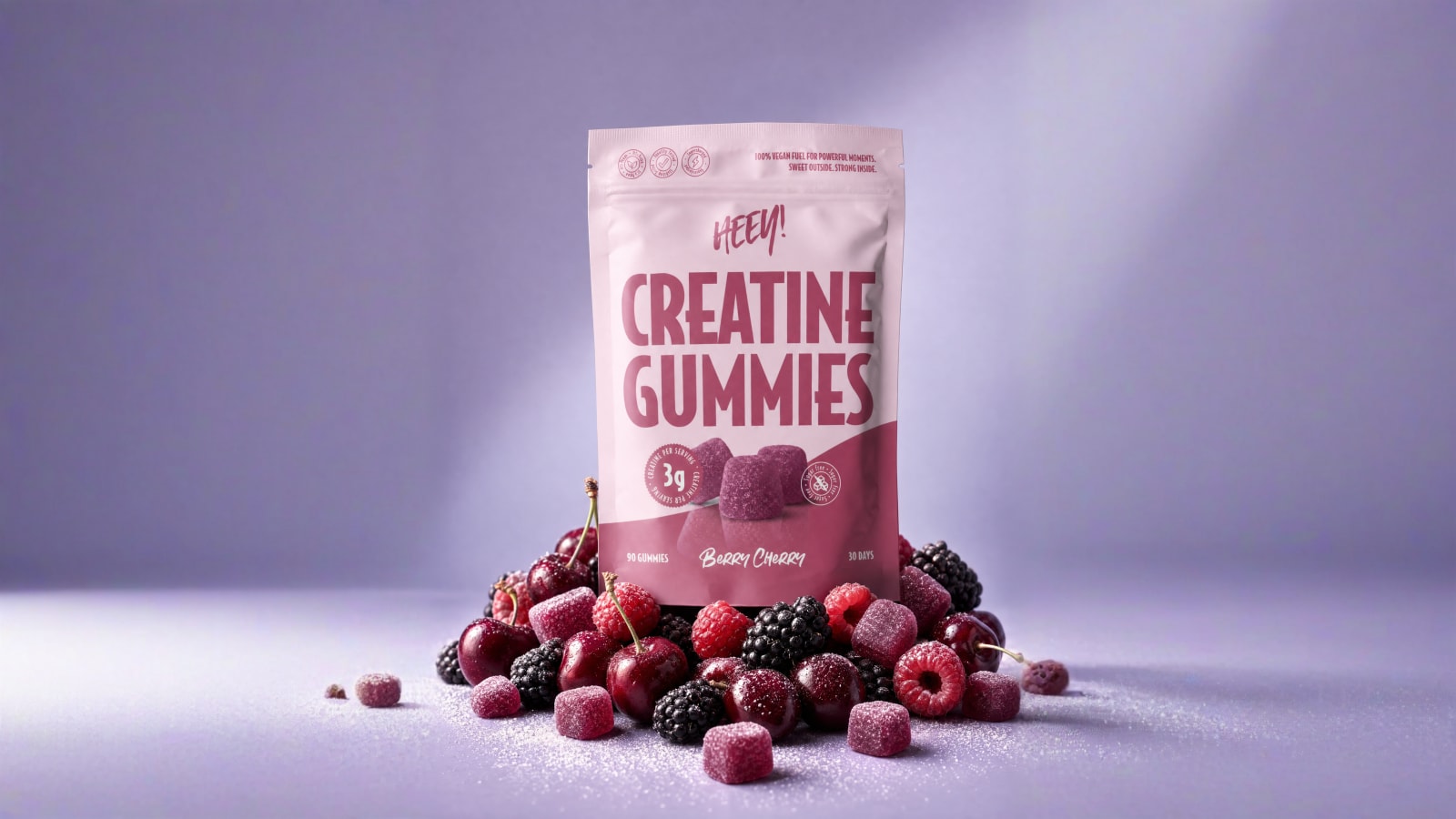
Heey! Creatine Gummies are built to solve exactly what makes gummies frustrating: 3 gummies provide 3 g of creatine monohydrate, a full EFSA dose in three pieces, not five. They are sugar-free, 100% vegan with pectin instead of gelatin, and come in two flavours, Sour Peach and Berry Cherry. Soft to chew, stability-tested so the dose in the first gummy is the dose in the last. 90 gummies per pouch lasts a whole month at 3 a day.
If you prefer cheapest per gram, there is Heey! Creatine Monohydrate in pure powder form, 100% pure creatine monohydrate, vegan and made in Sweden. Same molecule, lower price per gram, no flavour.
Both provide the same active substance. The difference is the format, and you choose the format to fit your everyday life. Creatine increases physical performance in successive bursts of short-term, high-intensity exercise, with a daily intake of 3 g.

The format question, solved
Heey! Creatine Gummies
Gummies become a problem when they are underdosed, sugary or made with gelatin. We built all three problems out. Full dose in three gummies, no added sugar, a fully vegan pectin base.
- 3 gummies = 3 g of creatine monohydrate, a full EFSA dose
- Sugar-free and 100% vegan, pectin instead of gelatin
- Two flavours, Sour Peach and Berry Cherry, soft to chew
- 90 gummies per pouch, 30 days at 3 a day, stability-tested
Common questions about creatine gummies
Do creatine gummies work as well as powder?
How many creatine gummies should you take per day?
Are creatine gummies vegan?
Do creatine gummies contain sugar?
Creatine tablets or capsules, what is the difference?
Which creatine format is cheapest?
Are creatine gummies and kreatin gummies the same thing?
Do you need a loading phase with creatine gummies?
Can you take creatine gummies every day, year round?
What are the downsides of taking creatine?
Why do doctors say no to creatine?
Sources
- EFSA, Scientific Opinion on creatine and physical performance
- Livsmedelsverket (Swedish Food Agency), Food supplements
- PubMed, ISSN position stand: safety and efficacy of creatine supplementation (Kreider et al., 2017)
- PubMed, Common questions and misconceptions about creatine supplementation (Antonio et al., 2021)

Leave a comment