




Consumer guide · Updated 2026-06-11
Collagen put to the test 2026: what the tests don't tell you
Who is behind the ratings, what they actually measure, and 7 criteria that let you judge for yourself.
Quick answer: If you go looking for the best collagen on test, the ratings you find come from affiliate sites, retailers and brands that have tested themselves. No independent lab test of collagen supplements has been published in Sweden. Here is what the lists actually measure, and the criteria that let you judge for yourself.
Type "best collagen" into Google and you are met by a wall of stars, ratings, reviews and test winners. What none of those pages tell you: no independent lab test of collagen supplements has been published in Sweden. The ratings come from sites that earn a commission when you click, from shops ranking their own range, or from brands that have crowned themselves the winner. That does not make the lists worthless. It means you need to know how to read them.
What you'll learn: who is behind the "best in test" lists, what the ratings measure and what they cannot measure, whether collagen is a scam or not, which 7 criteria actually decide whether a supplement is any good, and how to choose between powder and capsules.

Who is behind the "best in test" lists for collagen?
The lists you find on page one come in three varieties, and none of them is an independent test in the sense most people imagine:
1. Affiliate sites. Sites built around comparisons and ratings, where every "Buy here" button is a commission link. The site earns money when you click and buy. That does not automatically make the content wrong, but it does mean the ranking and the selection are shaped by which products have affiliate programs and what commissions they pay. Serious affiliate sites disclose "ad links" somewhere on the page. Look for that.
2. Retailers. Shops comparing products they sell themselves. The comparison can be informative, but the "winner" is always in their own range, and the margin per product is not something you get to see.
3. The brands' own tests. Brands publishing articles where their own product is the test winner. That is advertising in article format, nothing else.
What is missing entirely in this category: independent editorial or laboratory tests of the kind that exist for, say, electronics and children's products. No Swedish consumer organisation or testing institution has published a lab test of collagen supplements. The basic rule from Konsumentverket (the Swedish Consumer Agency) applies: advertising must be recognisable as advertising, but on "best in test" pages that line is often blurry. That is why we are writing this guide instead of showing you a score.
What the tests measure, and what they cannot measure
When a list gives a collagen supplement 8.4 out of 10, what has it actually measured? In practice, three things:
- The ingredient list. Form, dose, additives, origin. This can be read off the label and is genuinely useful.
- The price. Often as price per dose. Also useful, if it is calculated correctly.
- Taste and solubility. Subjective, but relevant for powders.
What no list measures: effect. Collagen's documented effects on skin elasticity require 8-12 weeks of daily intake and are measured in studies using specialised instruments (Proksch 2014, Bolke 2019). No "best in test" site follows test subjects for three months with measuring equipment. So the score says nothing about what the product does for your skin, only what is printed on the pouch and what it costs.
That is no surprise, real effect studies are expensive. But it is worth knowing that "test winner" in this category means "best ingredient list according to the site's criteria", not "proven best effect".
Is collagen a scam?
No, but the question is fair, and it shows up in Google's own suggested questions for this search.
The short answer: collagen you eat does not automatically become collagen in your skin. It is broken down into amino acids and peptides in the gut, which the body then uses wherever it wants. At the same time, randomised studies show that hydrolysed collagen peptides give measurably improved skin elasticity and hydration after 8-12 weeks of daily intake. Both things are true at once: the simplest marketing promises are wrong, and the supplements are still not ineffective.
The most important thing to understand is that the body builds its own collagen, from amino acids and vitamin C, throughout life. EFSA-approved health claim: vitamin C contributes to normal collagen formation. We go through the whole mechanism, the format comparison and the state of the research in our big collagen guide.

The checklist: 7 things to demand from a collagen supplement
These are the criteria that actually matter. Do the maths yourself and you will not need a list:
1. Clear form and dose. For animal collagen: hydrolysed peptides with the gram amount stated (2.5-5 g for skin). For a vegan collagen builder: named amino acids with stated amounts. If it just says "collagen complex" with no numbers, put it back. 2. Vitamin C in the formula. Vitamin C is a mandatory cofactor for collagen synthesis. A formula without vitamin C (or a plan to get it from your diet) is incomplete. 3. Full transparency in the ingredient list. Every ingredient with its amount. A "proprietary blend" without amounts is a warning flag. 4. Clear vegan status and allergens. Marine collagen is unsuitable if you have a fish allergy, bovine if you have a beef allergy. A vegan collagen builder contains no animal allergens. You should be able to see this at a glance. 5. Origin and manufacturing. Where is the product made? Traceability is a mark of quality. 6. Realistic promises. Serious senders talk about 8-12 weeks. "Visible results in 7 days" is not research, it is copy. 7. Price per dose, calculated by you. Take the price, divide it by the number of doses. Big pouches with a low dose per serving look cheap but rarely are.
A product that passes all seven is a good buy no matter what any list thinks. One that fails on two or more is not, whatever its score.
Collagen powder or capsules?
The format is one of Google's most common follow-up questions, and the answer is less about effect and more about which routine you actually stick to:
Powder suits you if you already mix a shake, take creatine after your workout or want your supplement as a drink ritual. Larger doses fit (gram levels), and you can combine several functions in the same glass. Downside: it needs water, a glass and a habit.
Capsules suit you if you want it simple: two capsules with breakfast, done. Nothing to mix, easy to travel with. Downside: the dose per capsule is smaller, so formulas with gram amounts require a lot of capsules.
In terms of effect it is the contents that count, not the format. Amino acids and peptides are absorbed in both forms. Choose the format you will take every day, because consistency is the only thing that delivers results.
Heey offers both routes: Boost & Glow as a powder for your training routine and Beauty Collagen + Hyaluronic Acid as capsules for skin focus.
How Heey holds up against the checklist
Fair question: how do our own products stand up against the criteria we just gave you? We will take it point by point, and we will start with the uncomfortable part.
Has Heey won a collagen test? No. There is no independent test to win, and we are not going to pretend otherwise. What you can scrutinise is the contents:
1. Form and dose: Coll-egan® is a patented vegan collagen builder with named amino acids (L-glycine, L-proline, L-glutamic acid, L-alanine, L-arginine). 660 mg per dose in Boost & Glow, 400 mg per daily dose in Beauty Collagen. 2. Vitamin C: included in both, via acerola in Boost & Glow and with 80 mg (100% DRI) in Beauty Collagen. The cofactor the EFSA claim about normal collagen formation rests on. 3. Transparency: full ingredient list with amounts on every product page. 4. Vegan status and allergens: 100% vegan, no fish or beef allergens in any product. 5. Origin: developed and made in Sweden. 6. Realistic promises: we say 8-12 weeks, because that is what the research says. 7. Price per dose: Boost & Glow has 50 servings per pouch, Beauty Collagen 90 capsules. Do the maths, that is why the numbers are there.
And the credibility beyond the checklist: Heey is sold by Swedish pharmacy chains and supplement stores, including Apotea, Apotek Hjärtat and Meds, and is trusted by 200,000+ customers. That is the kind of scrutiny we can actually show.
You'll find the full range in our collagen collection.
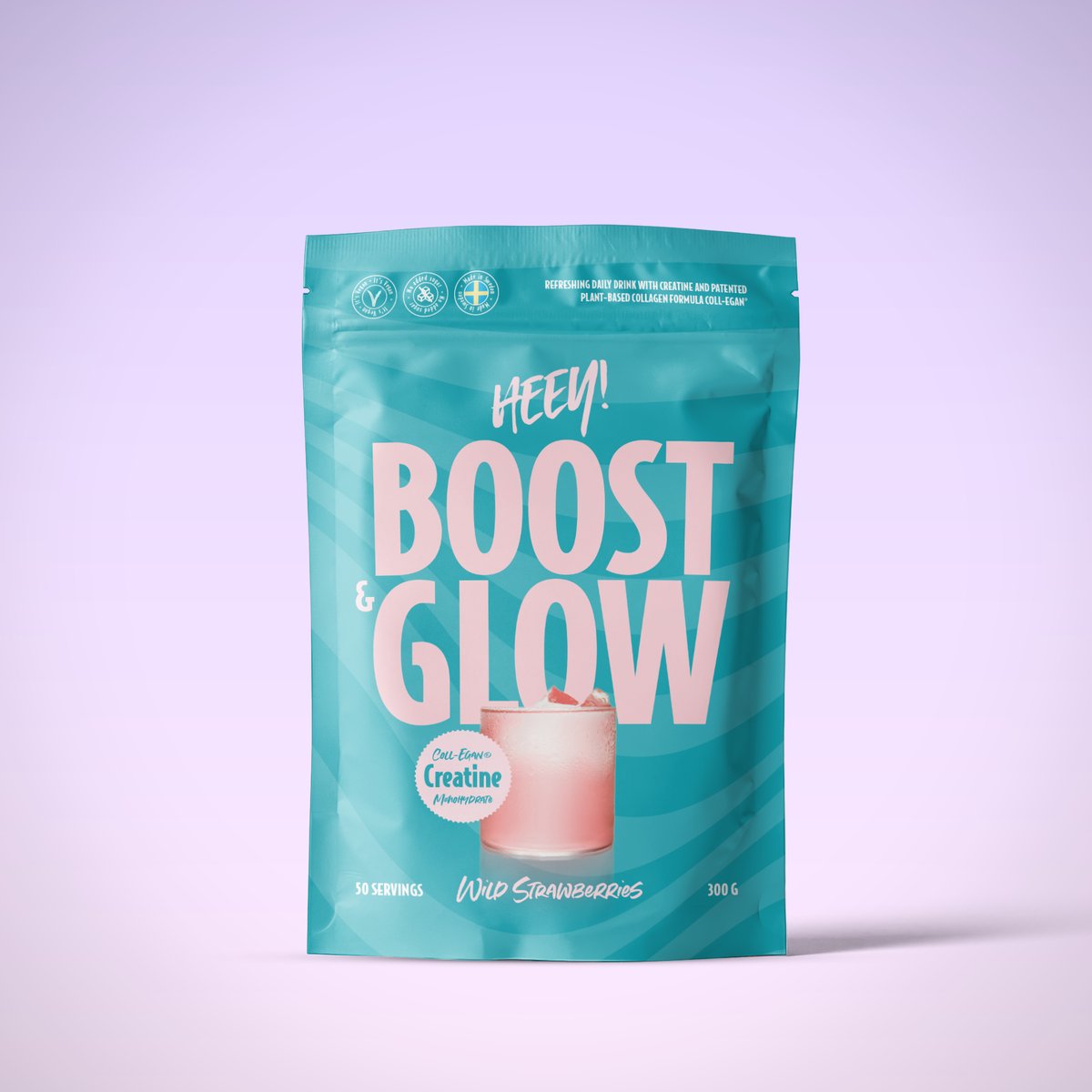
This is what we take ourselves
Boost & Glow Creatine + Coll-egan®
The powder for you if you want strength and glow to be the same routine. Creatine monohydrate for your training, Coll-egan® with vitamin C from acerola as raw material for the body's own collagen production. A glass of water after your workout, done.
- 3 g creatine monohydrate per dose, the form with the most research behind it
- Coll-egan® 660 mg, a patented Swedish vegan collagen builder with named amino acids
- Vitamin C from acerola, the cofactor for normal collagen formation (EFSA)
- 100% vegan, 50 servings per pouch, three flavours: Lemon, Wild Strawberries and Ice Tea Peach
What customers say
- "Wild Strawberries tastes like Swedish summer, I take it right after my workout."
- "Two supplements in one, that's what made me switch."
- "Noticed a difference in my skin after about two months, nails as a bonus."
- Free shipping over 449 kr
- 1-3 day delivery
- Ships from Sweden
Common questions about collagen put to the test
Is collagen a scam?
Which is best, collagen powder or capsules?
Which collagen is best for osteoarthritis?
Is it good to take collagen every day?
Is there any independent test of collagen supplements?
How do I know whether a best in test page is independent?
Which collagen is best for skin?
What should I look for in the ingredient list?
Is more expensive collagen better?
Is vegan collagen worse than marine collagen?
How long before collagen has an effect?
What is Coll-egan®?
Sources
- Livsmedelsverket (the Swedish Food Agency) · Collagen supplements, are there positive effects?
- Proksch E et al. 2014 · Oral supplementation of specific collagen peptides has beneficial effects on human skin physiology, RCT n=69
- Bolke L et al. 2019 · A collagen supplement improves skin hydration, elasticity, roughness, and density, RCT n=72
- Lund University · The Osteoarthritis Portal, natural remedies for osteoarthritis
- European Commission · Register of approved health claims (vitamin C and collagen formation)
- Konsumentverket (the Swedish Consumer Agency) · Rules for advertising and marketing
- 1177 Vårdguiden (Sweden's national healthcare guide) · Diet and health

Leave a comment